
The ability to focus is a crucial thing to have, yet how many times you find yourself able to maintain focus?
If intentional focus cannot happen at will, then you have a mental training to do.
Dan Koe is a person who turned his simple life into someone who is creating many interesting things.
He successfully:
- gained +3 Million of subscribers
- Created a wealth of +4 millions dollars as digital creator
- Created many courses such as: The 2 hours writer and digital economics
- and authored two books, one of them is what we going to cover in this blogpost
And all these achievements boils down to focus. Focus what helped him generate such crazy results.
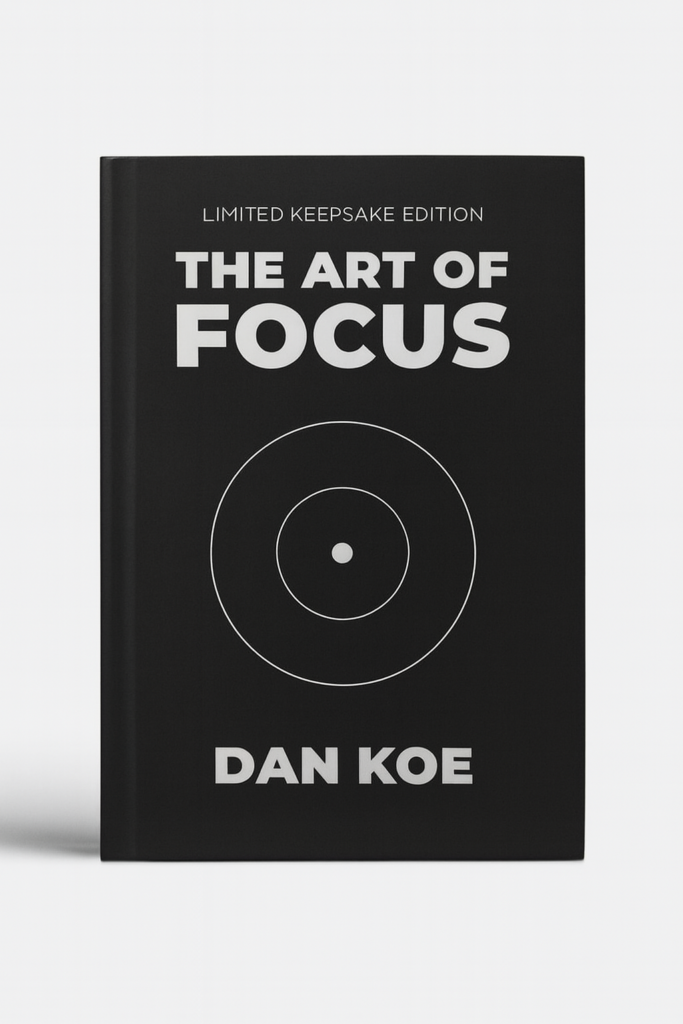
And so Dan transferred his experience of being focused through his book called:
The art of focus.
To decide to take the path of focus you are opening new avenues of growth but it won’t be an easy one.
Dan puts it this way:
The journey you are about to embark on is not for the faint-hearted. It is not an external journey, but an internal one. Not a material journey, but immaterial. Not a physical journey, but spiritual. If all I had was a socially accepted definition of a beautiful person of the opposite sex, an abundance of American currency, a nice machine on wheels, and an aesthetic form of my physical body, my life would be all looks and no depth. It would mean nothing. It would serve nothing. It would continue existing as nothing of true value.
So focus is a reflection of depth.
Your entire work depends on focus, Dan words this it in this passage:
Focus influences the quality, impact, and virality of your work. Focus is the start of all things good. Habits, routines, goals, health, relationships, finances, mood, and sense of purpose. All the things that you know hold power but can’t seem to reap the benefits from.
Now, how can someone finds focus in a distracted world?
We need a bird’s eye view perspective.
You can’t find focus in the little of things, that’s just the small kind of focus and it’s not sustainable anyways. Many people can focus on watching few episodes from Netflix but struggle horribly reading one page of a nonfiction book.
So it’s crucial to summon the big picture first, then tackle the focus as skill next.
Besides the bird’s eye view or zooming out as Dan likes to call it, he listed other principles that helps strengthen focus .
I am not going to mention them all but I will list 5 principles I think are important to know. They will help you thinking about the meaning you want to create.
System thinking → develop the ability to see the connection between things and detect an entire flow of connected ideas in which it helps you quickly analyse your situation and implement the solutions needed.
Self-experimenting → if you are not willing to try tens of different things then probably you won’t end up with something that works great for you.
Intelligent imitation → since birth we managed to copy people around us to learn things, we copied their speech, their body movement and whatever we want to learn. We just have to keep that in our adulthood, by imitating experts and those who inspire us to be better, we start creating mini changes that compound into the focused goal we want to achieve.
Creative vs productive → one should automate what can be automated and leave the creative work to oneself.
Iteration and Persistence → Any perfect product or successful launch of a project is not the result of perfection. It only came to existence thanks to the countless failed iterations and stages of growth. Without persisting through every one of these failures, success is not possible.
What are the three pillars of success?
Dan spend a great deal of time studying many successful people and he found that focus was the common denominator among them.
Focus is the very foundation of success and it’s considered the first pillar. Focus is a good metric to measure if you are walking the path toward your goals, and to realise your goals, you need to master focus-shifting. By shifting to the things that matter to you the most according to the stage you find yourself in the hierarchy of goals.
You might ask what is the hierarchy of goals, Dan puts it beautifully this way:
Your hierarchy of goals, from the top down, ideal future to present action, will frame your focus in an indistractable manner.
The next pillar in terms of importance is energy.
To link energy to focus, we can quote the saying that says “energy flows where attention goes“
Dan invites us to feel our energy during the tasks, the conversations we have, the goals we want to achieve. It’s about observing our energy and how its unfolding.
One thing that Dan talked about in his book is using the law of entropy as analogy.
In physics terms, law of entropy is the second law of thermodynamics in which it says that in an isolated system, entropy tends to increase over time.
We can use the analogy of having books in a shelf. As time passes (and when order is not applied), books tend to be misplaced, dust accumulates and chaos ensues. In order to bring back the original order, one has to exert some energy.
Same with focus, if it’s not properly used, attention fades and distraction takes over. And so we end up spending more energy just to bring our focus to the desired object of attention. That’s why it’s crucial to always protect our energy.
The third pillar is experience.
Where focus and energy would be if they are not used in gaining experience?
Not much change could happen.
”The essence of experience, life, and science is trial and error. You cannot take ideas, opinions, or advice as law without the filter of direct experience.” — Dan Koe
One of the most important points of having experience is that it lets you test any system and method devised by others. It helps you avoid believing in things blindly, you do get to say if this is true to you, and only that is possible if you have a direct experience of it.
The Micro, the macro and the game
You have to understand that your existence (micro self) is existing within a very complicated system, the cosmos (the macro self). Yet you have to notice the interconnectedness of the lower you to the higher you. When we look up to the sky, we are reaching for things beyond the self to achieve something infinite and isn’t defined by our physical limitations.
To seek a better future, is to want to think as big as the cosmos is.
But that’s just the beginning, a better future is only achieved through selecting a long term goal.
You pick a long term goal (the game you want to play):
You build the skills needed to walk toward the goal
You turn your skills into a project
That project is turned into a product.
Then you sell it through your sales and marketing skills.
That’s what holistic focus boils down to.
You focus.
You consume.
You create.
You distribute.
You get rewarded.
Applicable steps devised by Dan to increase focus
Now that we covered the big picture of achieving focus holistically, what are the pieces of advice of dan to increase Focus as singular activity:
- Create a distraction free environment
- Hold a clear bigger vision of what you are trying to work towards (internal work)
- Following a specific routine that helps you execute (external work)
- Focus is built with time, start with 15 minutes and increase over time.
- Aim for 3-5 hours of focus session per day, which is the sweet spot of being focused
- Use rest and walking to recharge between your focus sessions and gain more insights
IMPLEMENTATION PHASE
What’s the point of reading if you don’t have a work to do after you finish reading it?
Here are few exercises (depending on the problem you feel most urgent), you pick one and work on it for a week or so to see some results.
If you are struggling with negative emotions that makes you distracted then:
“Treat negative feelings as a test of awareness. When you feel a disturbance in your inner peace, follow that feeling along the string until you reach the source, which may be much, much deeper than you could ever imagine” — Dan Koe
Having a specific problem but you can’t bring yourself to solve it?
“Understanding your problems means to perceive them from the highest level of mind available to you. From that expanded perspective, you can begin to experiment, iterate, and create a long-term personal solution.” – Dan Koe
If you think you are lost in a web of distraction and you can’t find your way back to focus, then:
Take a journal and answer these two questions:
What you don’t want? Where will you end up if you keep doing what you are doing?
After answering the same question for a minimum of week you can identify what truly you don’t want, and you realize how damaging your current habits to your future self.
Now you have an anti-vision to what you don’t want to become.
What is your purpose path priority?
Purpose → define what you want to become
Path → Pick a path to develop the right skills for the purpose to be materialized
Priority → You put the daily tasks related to your purpose as top priority.
Here are my responses to the answer above, at least the main idea I found kept repeating:
I had 7 days of contemplation, by the day 7, I end up having an answer that captured the bits I covered across the days.
What I don’t want?
I don’t want to live a marginalized life that is full of entertainment, surface-level thoughts with very little ambition and distracted existence one which amounts to nothing.
Where will I end up if I keep doing what I am doing?
I will end up dead inside before my physical death, it would lead to a life that is engaged with reality as if I was just a visitor not someone who has a grounded touch with it and ready to make a change that is worth talking about long after my death.
Now this is my purpose path priority:
Purpose → Deconstructing and constructing my mental and physical state through learning, seeking depth and engaging in behavioral change.
So, what do I mean by deconstructing and constructing?
Deconstructing is about unlearning and breaking older patterns.
Constructing could be about building new habits and adopting new mindset.
Together they help me to gain a greater flexibility my mind and also should improve my overall physical and mental health.
Path → Meaningful work that is shared through plannedroutine.
priority → prioritize my daily habits, writing about the gained insights to help you effortlessly unplug from the bad habits and incorporate powerful ones that are capable of improving some aspects of your life.